An encyclopedia of French cheese
216 French cheeses, one entry for each.
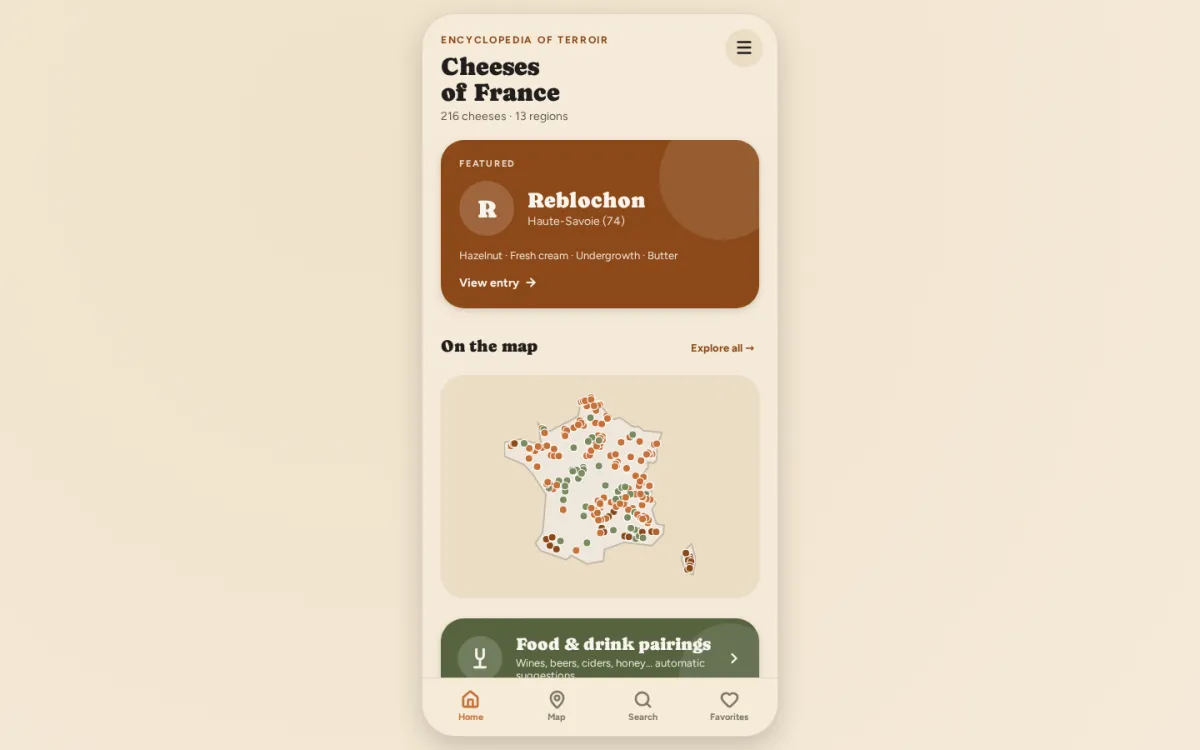
Fromageor tells the story of the cheeses from all 13 regions of mainland France: where they come from, how they are made, what to serve them with and how to cut them. Free, no account needed, and it even works offline.
- 216 entries
- 13 regions
- 47 AOP
- FR · EN bilingual
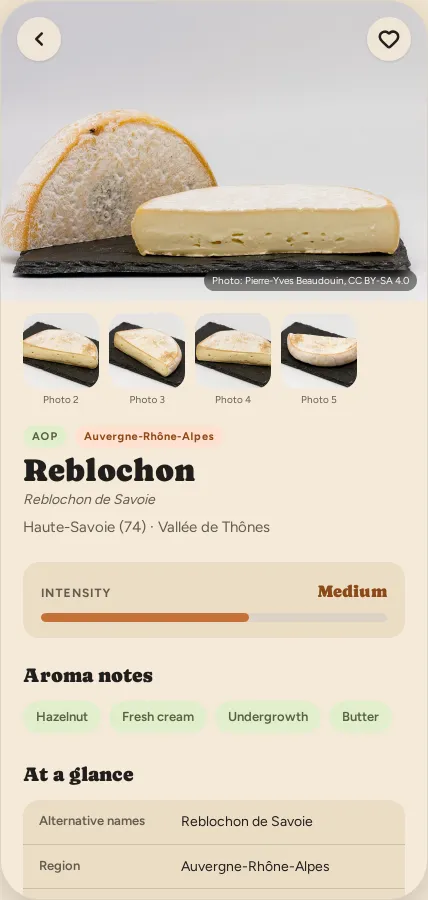
Photo of Reblochon in the app: Pierre-Yves Beaudouin, CC BY-SA 4.0

A pocket guide to the cheese counter
At the cheesemonger’s, while putting a board together, or just out of curiosity: Fromageor answers the questions people actually ask. What milk? Which region? Does it go with this wine? How do you cut it without ruining the rind?
It is made for the curious and for seasoned cheese lovers alike. Entries are checked against public sources: 163 of them cite the cheese’s Wikipedia article, and 145 show a photo with its author and licence.
- At the market — identify an unfamiliar cheese and check whether it is in season.
- In the kitchen — build a board that mixes milks and regions.
- On holiday — see on the map what is made in the next valley.
What you can do with Fromageor
Nine tools, all available in the app today — and all usable offline.
A full entry for every cheese
Milk, breed, type, rind, ageing, season, intensity, aroma notes, history and storage — plus, where one exists, a sourced photo from Wikimedia Commons.
Example: The Reblochon entry lists its breeds (Abondance, Tarine, Montbéliarde) and its aroma notes: hazelnut, fresh cream, undergrowth, butter.
The map of France
Every cheese is a dot on the map, coloured by milk. Filter by AOP, by milk or by type of cheese.
Example: Filter on “Sheep” and Corsica, the Basque Country and the Causses stand out.
Full-text search
It searches names, aroma notes, regions and appellations, and combines with a milk filter.
Example: Type “bleu” to bring up the Bleu d’Auvergne, Bleu de Gex, Bleu des Causses…
Food & drink pairings
Suggestions by cheese family: wine, champagne, beer, cider, perry and whisky, but also bread, jam and honey.
Example: Aged pressed cheeses lean towards tannic reds; triple-crèmes towards champagne.
The right way to cut
6 methods, each explained step by step, with the list of cheeses it applies to.
Example: A camembert is cut like a pie, so every wedge gets the same share of heart and rind.
The seasonal calendar
Month by month, the cheeses at their best, so you know what to ask for at the cheesemonger’s.
Example: The Reblochon entry gives its season as “Summer → Winter”.
Your favourites lists
As many lists as you like — “to try”, “Christmas board”… — filled from any entry.
Example: Lists stay on your device: no account is needed.
The encyclopedia
8 in-depth articles to understand what you are tasting.
Example: History of cheese · How cheese is made · Ageing · Moulds · Ageing cellars · Cattle breeds · Goat breeds · Sheep breeds
Appellations
The 47 AOP cheeses in the collection and the IGPs, gathered on one screen.
Example: Reblochon is AOP; its entry shows it with a badge.
The app, as it is
Screenshots taken from the live version, unretouched, with the interface switched to English. Designed for phones first, the app is shown in a centred frame on a computer.
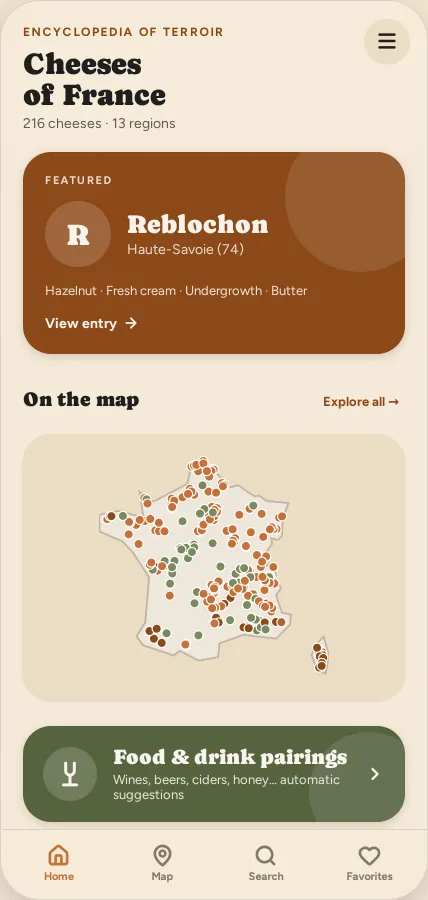
Home 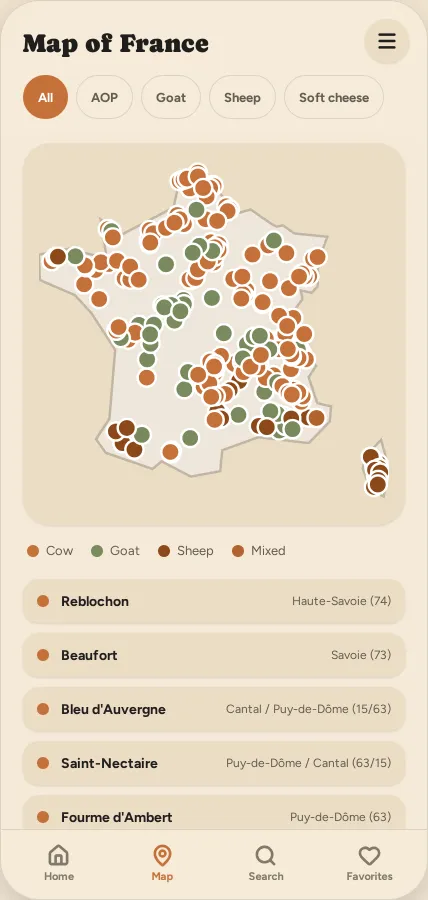
Map of France 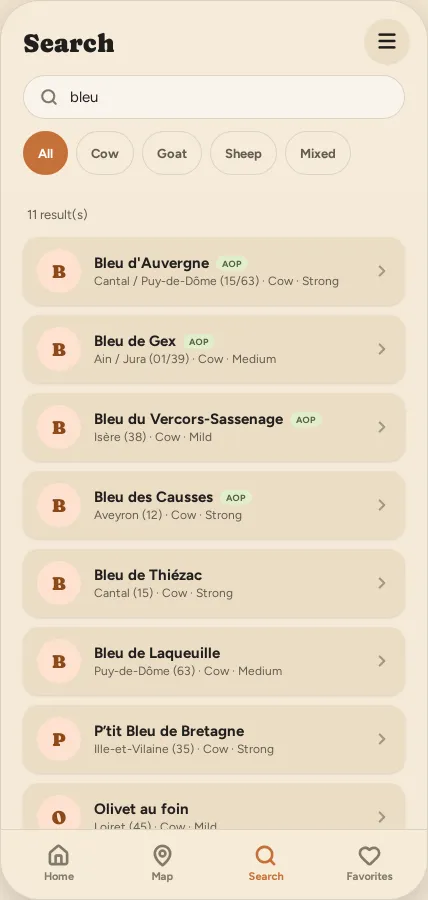
Search 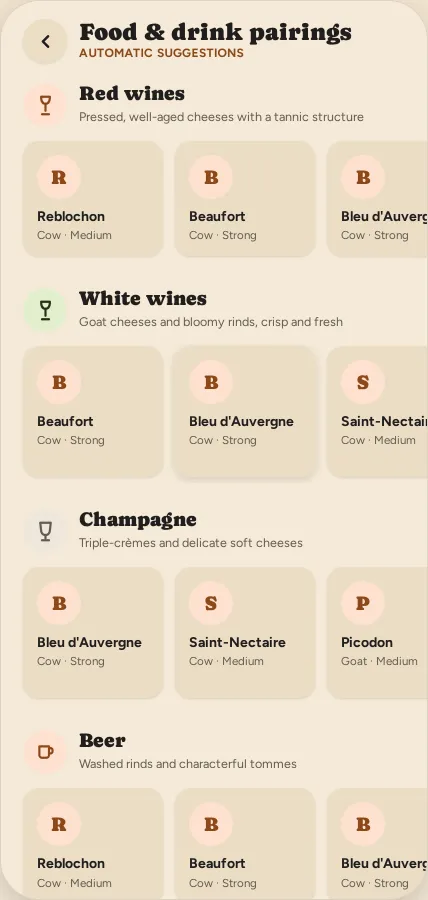
Pairings 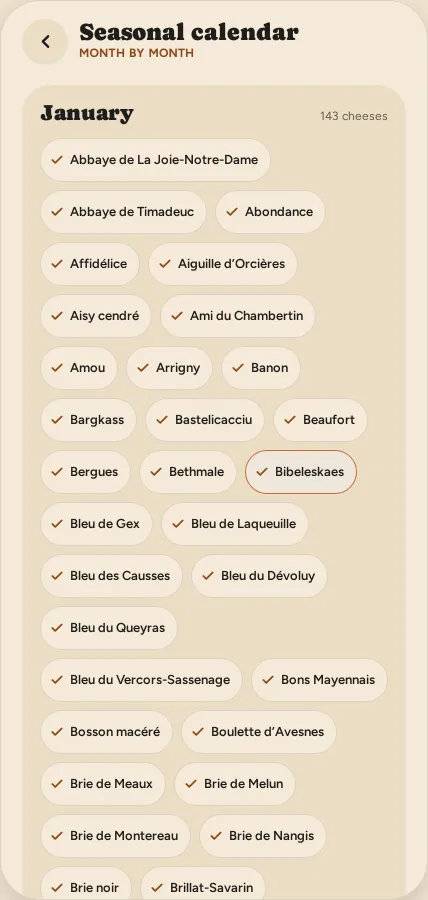
Calendar 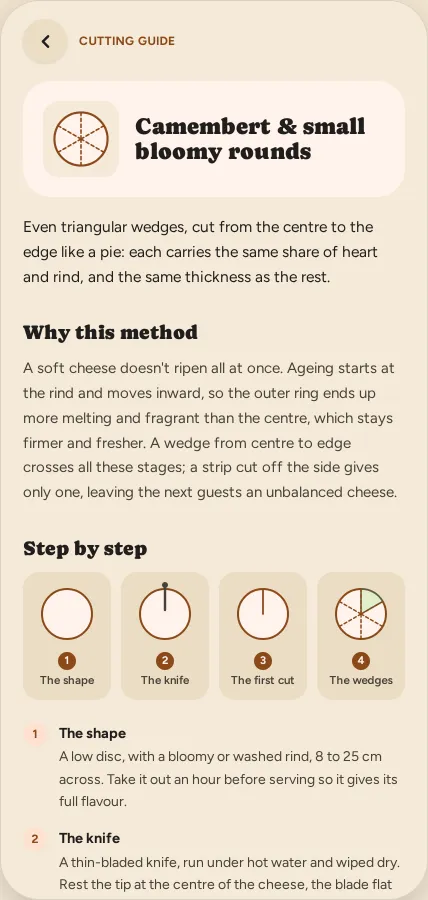
Cutting
The cheese photos shown in the app come from Wikimedia Commons; their author and licence are given on each entry.
Why Fromageor?
A whole heritage, in one place
216 cheeses across 13 regions, from the most famous to the most obscure:
- Auvergne-Rhône-Alpes 49
- Provence-Alpes-Côte d’Azur 20
- Nouvelle-Aquitaine 19
- Hauts-de-France 18
- Bourgogne-Franche-Comté 17
- Occitanie 14
- Centre-Val de Loire 13
- Normandy 13
- Grand Est 12
- Brittany 11
- Île-de-France 11
- Corsica 10
- Pays de la Loire 9
Information you can use
Not just “what it is”, but what to do with it: when to buy it, what to serve it with, how to cut it and how to keep it.
Fast, discreet, always there
No account, no ads, no tracking. Once loaded, the app responds instantly — even deep in an ageing cellar with no signal — and updates itself.
Get started in two steps
Fromageor opens straight in your browser. To keep it at hand like an app, you can also install it — that part is optional.
Open the app
Go to fromageor.swinux.ch. On first launch, a short notice reminds you that the information is for guidance only. The interface is in English from this link; the FR / EN switch at the top of the side menu changes it at any time.
Install it if you like
- Android — Chrome or Edge: browser menu, then “Install app” or “Add to Home screen”.
- iPhone, iPad — Safari: Share button, then “Add to Home Screen”.
- Computer — Chrome or Edge: install icon in the address bar.
Depending on your browser and device, the option may have a different name or may not be offered: the app then remains fully usable in a tab.
Frequently asked questions
What is Fromageor?
An encyclopedia of French cheeses, region by region, as a web app. It offers detailed entries, a map, pairings, cutting advice and a seasonal calendar.
How do I get it?
Just open fromageor.swinux.ch in a recent browser, on a phone or a computer. Nothing to download from an app store.
Is it free?
Yes. There is no subscription, no in-app purchase and no advertising.
Do I need an account?
No. There are no accounts and no server: your favourites and settings are stored in your browser. The app collects no personal data and uses no analytics.
Can I install it on my phone?
Yes, it is an installable web app (PWA): on Android with Chrome or Edge, on iPhone with Safari. See the steps. Without installing it, it works just as well in a browser tab.
Does it work offline?
Yes, once it has been opened online a first time: entries, search, the map, favourites and all the guides are stored on the device. Only the photos, hosted by Wikimedia Commons, may be missing offline.
Is everything in English?
The whole interface is, and so is the content of every entry: history, how it is made, storage, serving, aroma notes and pairings. Some at-a-glance details (type of cheese, rind, ageing) and the quoted Wikipedia summaries stay in French. A FR / EN switch at the top of the side menu changes the language at any time.
Where does the information come from?
Entries draw on Wikipedia and Wikimedia Commons; whenever a summary or a photo is taken from them, its source and licence are shown on the entry. The information is for guidance only: see the legal notice (in French).
Which cheese will you discover today?
216 entries are waiting. No sign-up, no download.
Open Fromageor